Showing posts with label garcia marquez. Show all posts

Monday, March 07, 2011

fate

In Posthegemony I point out that “For all his fame as a novelist of magical realism, and so purportedly of surprise, creativity, and delight, Gabriel García Márquez is as much a writer of habit, tedium, and repetition” (178). This is nowhere more true than in the Colombian writer’s early novella, La hojarasca.

Of course, it is not as though García Márquez were only a writer of “habit, tedium, and repetition.” The very concept of the “hojarasca” or leaf storm that gives this book its title suggests the tumultuous forces of modernization and industrialization that tear through even a town as remote as Macondo (introduced here for the first time) in Colombia’s otherwise sleep Caribbean litoral:
Suddenly, as if a whirlwind had set down roots in the center of the town, the banana company arrived, pursued by the leaf storm. A whirling leaf storm had been stirred up, formed out of the human and material dregs of other towns, the chaff of a civil war that seemed ever more remote and unlikely.
Even here, though, in the story’s opening lines, there are some strange tensions. What does it mean for a whirlwind to “set down roots”? Even the exceptional becomes, somehow, rooted in the everyday--and isn’t this after all the classic formulation of magical realism? Or at least the whirlwind becomes routine until, just as suddenly as it arrived, it leaves.

For the events recounted in La hojarasca take place long after the leaf storm has up and left. And these events are minimal indeed: we are in a boarded-up house where an old man (a doctor who has long since abandoned his practice) has died, has committed suicide by hanging; another old man (a similarly long-retired colonel), with his daughter and her son, has come to the scene to prepare for the ensuing funeral. The dead man’s body is placed in a coffin; there is a minor disagreement with the mayor as to whether the burial can go ahead as planned; finally, it is agreed that it can, and the house door is forced open so the coffin can be carried out to the street. The whole action takes place over the course of exactly half an hour, between two and three o’clock on a Wednesday afternoon.

These small, ritual actions and the long pauses between them (the wait for the mayor to return in the suffocating heat) provoke a series of reflections and recollections on the part of the three members of the funeral party, and it is of these that the narrative consists: the old man and his daughter think back to their history with the dead man; the grandson observes them as they remember and considers what he might be doing otherwise, if it weren’t for this brief interruption to his routine. But even the history that the older two recount takes places almost entirely after the leaf storm has already departed, concerns long periods in which literally nothing happens, and focusses mainly on a couple of brief, dramatic interludes in which, again, stubbornly and unyieldingly, nothing happens.

Indeed, perhaps García Márquez’s genius resides, both here and elsewhere, in his masterly evocation of the intense drama he shows us can be found in anticlimax, in disappointment. In the end, everything takes place as it always would have taken place. García Márquez’s theme is this inexorability of a fate that at almost every point looked as though it could have been avoided, but never is.

Tuesday, February 20, 2007

genealogy

Cien años coverGabriel García Márquez's Cien años de soledad is a long, sprawling novel that lacks much in the way of a conventional plot. Rather, it is full of events and incidents, digressions and flashbacks or flashforwards, not least the famous flashforward with which the book opens:
Many years later, as he faced the firing squad, Colonel Aureliano Buendía was to remember that distant afternoon when his father took him to discover ice. (9)
In fact, in a further complication, this is a double flashforward: both to the story of the discovery of ice, recounted some twenty pages later; and to the story of Aureliano Buendía facing the firing squad, which will not be told for another several hundred pages.

But what does appear even in this opening sentence is one of the threads that connects and gives some sense to what might otherwise appear to be a jumble of narrative excess. For in what we take to be his final moments, by recalling the transmission of knowledge from father to son the colonel also highlights the theme of inheritance, of what is passed down from generation to generation. In short, of genealogy.

family tree
For there's no surprise that some editions of the novel include a family tree. Cien años de soledad is (among other things) a family saga. One of its central concerns is they ways in which sons and daughters, grandsons and grand-daughters, and even great-grandsons and great-grand-daughters, have, face up to, take responsibility for, or negotiate what they have inherited from their forebears.

Still early on in the novel, for instance, we see how José Arcadio Buendía (Aureliano's father) destroys or uses up his wife's inheritance--a trove of colonial gold coins previously buried under the matrimonial bed (11)--in his misguided zeal for alchemical progress.

Equally, José Arcadio and his wife, Úrsula, fear that their very marriage may set trouble in store for their offspring. In that they are cousins, and they have heard that other cousins in the family who married gave birth to a child with a pig's tail, they fear their children will likewise be monstrous. For months after their wedding, Úrsula refuses to allow the relationship to be consummated, out of fear for what might issue. They only start to reproduce after a neighbour, Prudencio Aguilar, mocks José Arcadio for his failure to bed his own wife. "If you bear iguanas, we'll raise iguanas," José Arcadio tells her.

Yet indirectly the future has already been set for the couple's descendants. Spurred in defence of his honour to kill Prudencio Aguilar, José Arcadio has as a result to take Úrsula off in the founding Exodus that establishes the community of Macondo.

So Macondo is troubled from the start by the question of inheritance, of legitimacy, and the ways in which the sins of the fathers (and mothers) may be visited upon the sons (and daughters).

In other words, the novel is also troubled from the start by the ways in which, whether through incest or adultery or any number of other complications, the family tree soon becomes as unruly a structure as the narrative profusion that it is in part designed to contain and control.

Genealogy, intended to produce order and secure legitimate inheritance, is equally a source of disorder and confusion as Aureliano follows Arcadio but is followed in turn by other Arcadios and other Aurelianos. It becomes increasingly hard to keep up. The family tree is soon lost to the multitudinous forest.

Saturday, January 28, 2006

tiredness

"The body is never in the present," Gilles Deleuze notes, "it contains the before and after, tiredness and waiting. Tiredness and waiting, even despair are the attitudes of the body" (Cinema 2 189).

Gabriel Garcia MarquezGabriel García Márquez's "No One Writes to the Colonel" is concerned above all with tiredness and waiting--and so also the corresponding attitudes of the body. It provides, therefore, a version of what Deleuze terms the "time-image":
the series of time. The daily attitude is what puts the before and after into the body, the body as the revealer of the deadline. The attitude of the body relates thought to time as to that outside which is infinitely further than the outside world" (189)
The story opens with the colonel of the novella's title making his wife a cup of that ubiquitous stimulant, coffee, banishing tiredness with caffeine. The process is described in all its material determinants: the ground beans, the boiling fluid, and a series of containers that themselves leech into the resulting mixture as he "scrape[s] the inside of the can with a knife until the last scrapings of the ground coffee, mixed with bits of rust, fell into the pot" (109).

At the same time, we also get an early insight into the physical maladies that ail both the colonel and his wife. He finds his gut and stomach affected: "the colonel experienced the feeling that fungus and poisonous lilies were taking root in his gut" (109). She "had suffered an asthma attack" the previous night and "sip[s] her coffee in the pauses of her gravelly breathing. She was scarcely more than a bit of white on an arched, rigid spine" (109, 110).

The pair's deteriorating corporeal condition is a direct result of their long wait for the colonel's overdue pension. "For nearly sixty years--since the end of the last civil war--the colonel had done nothing else but wait" (109). And in the novella's sixty or so pages that follow, there is not much in the way of action except for the small routines that occupy the couple in their quiet, desperate poverty.

In the first few of these pages, the colonel makes coffee, winds the pendulum clock (one of their few remaining possessions, a constant reminder of time's passage), sees to the rooster they are keeping for a forthcoming cockfight, seeks out his suit, shaves, dresses... "He did each thing as if it were a transcendent act" (112). But of course these habits are far from transcendent; they are the endlessly iterated reflexes of a life spent waiting for transcendence, for a response from that department of state bureaucracy charged with allocating money to war veterans.

For of all the colonel's routines, the most symptomatic is his weekly trip down to greet the mail launch, follow the postman to the post office, and watch him sort the mail. "And, as on every Friday, he returned home without the longed-for letter" (127).

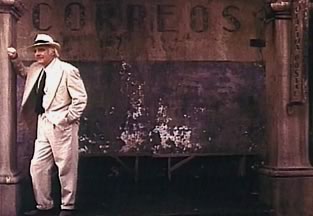
Colonel waiting
Still from the film El coronel no tiene quien le escriba

These are, then, bodies that have yet to be scripted into the national narrative. The colonel frequently and somewhat obsessively casts his mind back to his role in the revolution--in which ironically he himself was a type of mailman, whose own arduous journey delivering funds for the war is somewhat belated, arriving only "half an hour before the treaty was signed" (131). But he receives a receipt for his delivery, a proof of his service, and can't believe that it can now have been mislaid in the national archives. "'No official could fail to notice documents like those,' the colonel said" (131).

But indeed, despite the myriad documents and missives that circulate through the story--newspapers, pamphlets, an air-mail letter for the local doctor--the story emphasizes the lives and experiences that never achieve representation. All this writing is characterized by its absences, its lacks. The national papers are subject to censorship, demanding but also frustrating suspicious interpretation: "'What's in the news?' the colonel asked. [. . .] 'No one knows,' [the doctor] said. 'It's hard to read between the lines which the censor lets them print'" (119). While there's little hope that any outsiders will interest themselves in local happenings: "'To the Europeans, South America is a man with a mustache, a guitar, and a gun,' the doctor said, laughing over his newspaper. 'They don't understand the problems'" (127).

And though there are also clandestine missives and messages that attempt to make up for this representational lack, these endlessly say "the same as always," and the colonel doesn't even bother reading them (137).

Waiting, waiting, the colonel and his wife are subject to a "slow death" (165). But almost to the end, they maintain their patience, however much it is tried in their various squabbles as they figure out strategies to keep their bodies at least semi-nourished. Should they sell or keep the clock, and above all the rooster whose fight might lead to a big pay-out? "But suppose he loses," objects the wife (165).

In the end, the couple are reduced to something like what Giorgio Agamben terms "bare life". What are the two then to eat? And yet it is, strangely, this condition, in its loss of hope for transcendence and realization of pure, immanent materiality, that is portrayed as a moment of almost ecstatic ascesis. After all his hesitations, his anxiety, after all the ways in which he is ignored or taken advantage of by the state and local notables alike, somehow the waiting is over:
It had taken the colonel seventy-five years--the seventy-five years of his life, minute by minute--to reach this moment. He felt pure, explicit, invincible at the moment that he replied:

"Shit." (166)
(In the meantime, it would seem that García Márquez himself is now tired of writing.)